


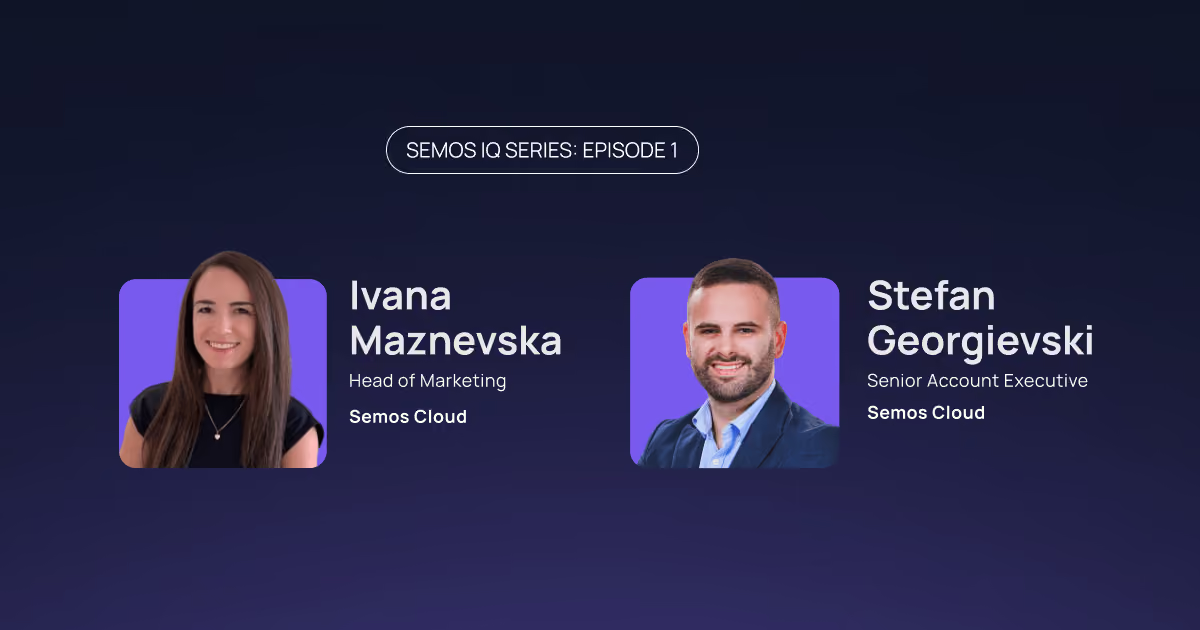
People programs rarely fail loudly. Messages get sent but never received. Survey data exists but sits in tools that do not talk to each other. Scores look stable right up until someone resigns. Episode 1 of the Semos IQ Series named the three gaps that produce that pattern, then worked through a live scenario inside Semos IQ: a survey built, another survey's results read, the diagnosis underneath them, and finally the specific employees and managers who could act on it. Four agents, one conversation, every decision made by a person.
Activity is not the same as improvement
Ask most People leaders how their programs are running and the answer is usually a list of activity. Communications are going out. Surveys are in the field. Recognition is live. On paper it looks like a system working as designed.
The harder question is whether the employee experience is actually improving, or whether the organization is just generating more activity. That question is uncomfortable because the reporting layer most HR teams have available cannot answer it. Dashboards report what was done. They rarely report what changed.
This is where Episode 1 of the Semos IQ Series started. Ivana Maznevska, Head of Marketing at Semos Cloud, hosted the session, and Stefan Georgievski, Enterprise Account Executive at Semos Cloud, took the audience through both the model and a live walkthrough of the product.
"Your communications are going out, your surveys are running, your recognition programs are active. On paper, everything looks like it's working. But is it? Is the employee experience actually improving, or are we simply generating more activity?"
- Ivana Maznevska, Head of Marketing, Semos Cloud
Underneath the activity sit three specific gaps, and they show up in almost every enterprise environment.
[cta]
Gap one: communication that does not equal reach
Organizations assume communication is happening because messages are being sent. Whether a message reached the right person, through the right channel, at the right time, is a separate question, and most systems were never built to answer it.
The scale of the problem is structural rather than tactical. Around 80% of the global workforce, roughly 2.7 billion people, is frontline or deskless. Most workplace tools are still designed for people sitting at a desk, and historically only about 1% of enterprise software investment has gone toward reaching everyone else.
Sending and landing are two different metrics. Most reporting only tracks the first one.
Gap two: data that does not equal understanding
The data that predicts a resignation is usually already inside the organization. It is just distributed across tools that do not talk to each other, so no single system holds enough of it to form a pattern.
The macro picture is not encouraging. Gallup's latest figures show global engagement fell to 20% in 2025, down from 23% in 2022, the first time it has declined two years in a row, and it declined in every region at once. Gallup estimates disengagement cost the world economy over $10 trillion in lost productivity in 2024, roughly 9% of global GDP.
The warning signs are almost always present before someone leaves. What is missing is the connection between them.
Gap three: metrics that do not equal reality
Every disengaged employee has a story, and most organizations do not hear it until the quarterly survey or the exit interview. By then it is history.
Semos Cloud data makes the cost of that delay concrete. Across more than 100,000 employees and over 4 million recognition moments on the platform, employees recognized at least twice a quarter carry a 60% lower attrition risk.
By the time disengagement is visible in a score, the moment where intervention would have changed the outcome has usually passed.
The structural problem: nobody owns all three
Each of these gaps already has an owner. Internal Communications owns reach. People Analytics owns signal. Total Rewards owns recognition. All three functions are doing their jobs.
What no one owns is all three at once. When communication, listening, and recognition run as separate programs, on separate data, on separate timelines, the connections between them never get made, because there is no place where they meet.
That is the problem Semos IQ was built to close: one connected layer sitting on the HCM an organization already runs, whether that is SuccessFactors, Workday, or Oracle, with more than 20 AI agents reading the combined signal and surfacing what needs attention. The agents surface insights and recommended actions. A person always makes the call. Everything runs natively on the SAP Business AI Platform, so nothing leaves the SAP environment the organization already governs.
Building a survey: the speed is not the point
The live walkthrough started with a common quarterly task. A wellbeing survey needs to go out, while last quarter's engagement survey has already closed with scores back and participation looking healthy.
It began with a prompt rather than a form. The agent asked what the survey should focus on and what tone the questions should take, then returned five drafted questions in seconds. One question was rewritten on request, with three alternatives offered. Then title, category, anonymity setting, and audience.
Speed was the least interesting part of it.
"This is a survey design cycle which normally runs for weeks, and everything I have done now took under a minute. But notice what actually happened. It gave me the questions, I rewrote one, I chose the category, I said who can see it, and it never decided anything on my behalf."
- Stefan Georgievski, Enterprise Account Executive, Semos Cloud
The audience step carried more weight than it appeared to. Audiences are built live off the HCM using job code, location, and employee group, and from there the survey can go out on any channel, including SMS and mobile notification for the employees who never open email.
"What's really important for me is that I never touched a distribution list, and nobody is going to be left out because they don't have a company inbox. Please keep this in mind for the rest of the session, because it's going to be the same for every agent we're going to see today."
- Stefan Georgievski, Enterprise Account Executive, Semos Cloud
The people most platforms never ask about
Reading the closed engagement survey produced a completion rate of roughly 72%, with 142 responses from 198 invited. Strong participation by any benchmark, and the point where most reviews stop.
The 56 non responses are usually treated as a single category. Survey fatigue, note it, move on.
"Hold on that 56, the people who did not respond. On most platforms that's just no response. You assume survey fatigue is happening and you move on. But this is what separates didn't answer from never received it. That second group is usually where the deskless part of the workforce is hiding, and that's a different problem, so it needs a different fix."
- Stefan Georgievski, Enterprise Account Executive, Semos Cloud
Same number, two entirely different problems, and only one of them is solved by a reminder.
The next layer down was more uncomfortable. Question two asked how often employees receive recognition for their work. Two thirds answered rarely or never, sitting directly underneath a completion rate that looked fine. The agent did not stop at the chart. It pointed to where the finding leads: manager training, or investment in the recognition program.
Three scores, and the arrow between them
One question is a finding, not a diagnosis. Asking the Employee Engagement Agent what should actually be worrying returned three critical findings: a career development vacuum, a recognition deficit, and manager effectiveness at a tipping point.
Any dashboard can produce three scores.
"Three different scores I could have just read off any dashboard. But what a dashboard is never going to give you is the arrow between them, and the fact that the two lowest scores are the two that actually compound each other. That's the most important part.That's the signal gap closing. Not more data. It's the same data, connected in a much better way. Everyone has the data, the core HR system has the data, but how are you going to unify it, and is that data talking between itself? From there you can make meaningful actions."
- Stefan Georgievski, Enterprise Account Executive, Semos Cloud
From sentiment to names, managers, and dates
Two of the three findings pointed at recognition, but the survey was anonymous. It says what people feel, not who they are.
Recognition records are a different data set with different governance. They are already identified, and a manager only ever sees recognition history, never survey responses. That separation makes it possible to check whether the behavior in the recognition data matches the sentiment in the survey.
Broken down by tenure, new hires looked healthy. Employees with over ten years of service sat at 31%. Broken down again by org unit, three came back critically low: Sales, Finance, and Legal. One level deeper produced the least recognized long tenured employees by name, with their manager and their last recognition date. Two of them, each with more than a decade of service, had never been recognized once.
"Two people, more than a decade each, never recognized once. That's not just a score I'm seeing on a slide. I have the name, I have the manager, I have the date. I've checked this list and it's exactly who I would expect flagged, so I want to get it in front of the right managers."
- Stefan Georgievski, Enterprise Account Executive, Semos Cloud
The list was reviewed before anything was sent, then manager notifications went out from a single prompt, each carrying tenure and last recognition date, with an automatic follow up scheduled if nothing changes.
What the walkthrough actually was
A signal arrived. A survey was built. Another survey's results were read. One chart pointed somewhere nobody was looking, the diagnosis explained why it mattered, and the recognition data produced specific employees and the four managers who could act.
Four agents, one conversation. No exports, no handoffs between three teams, no waiting for the quarterly report. Every instruction was typed by a person. The system found the pattern. The person made the call.
[cta-2]
What this changes for a People leader
Three things change, and each one has a customer behind it.
Timing. The pattern becomes visible while there is still something to do about it, instead of surfacing in an exit interview. A SuccessFactors customer in the CEE region chose Semos over a competing solution for exactly this reason. They did not want another standalone survey tool. They wanted pulse checks and full lifecycle surveys connected to the wider engagement picture. Semos IQ tracks over 50 behavioral signals to build that picture before it closes.
Reach across the whole workforce, not the part of it that sits at a desk. A retail customer with a predominantly deskless workforce sent over 1,300 targeted communications in their first year, with healthcare deadlines going only to eligible employees and job postings reaching the right store locations, all driven by attributes read live from the core HR system. A mining company in Canada came specifically for reach, with a safety and critical operations layer that reaches every employee from day one. In that environment, a message not received is not an engagement problem. It is a safety problem.
Recognition stops being a separate program reported on once a quarter. One customer replaced nine separate communication tools and a fragmented recognition experience with one connected system. Recognition and communications now arrive in real time, alongside everything else employees already receive.
"That's the pattern we're seeing across all three. Messages have to actually land. Problems have to be caught early enough that they still matter, so it's not just an exit interview. And recognition has to show up as behavior reinforcement, otherwise it doesn't make sense."
- Stefan Georgievski, Enterprise Account Executive, Semos Cloud
Watch the full session
This recap covers the through line of Episode 1. The live walkthrough is worth watching in full, particularly the survey build, the completion rate exchange, and the moment the recognition data resolves into specific cases.
In the full recording you'll see:
- A wellbeing survey designed, edited, categorized, and audienced end to end in under a minute
- Why a healthy completion rate can hide a reach problem, and how to tell the two apart
- How three separate engagement scores become one connected diagnosis
- Recognition rates broken down by tenure band and org unit, down to individual cases
- Manager notifications dispatched with automatic follow up, from a single prompt
About the speakers
Ivana Maznevska leads marketing at Semos Cloud and hosts the Semos IQ Series.
Stefan Georgievski is an Enterprise Account Executive at Semos Cloud, working with enterprise HR, communications, and total rewards teams on connected People and Culture Intelligence deployments.
What's next in the Semos IQ Series
Episode 2 moves to manager effectiveness, the lever identified in the diagnosis, and walks through the manager agents in the same live format. Registration is open now.
Ready to see it with your own data?
If any of these three gaps sound familiar, the fastest way to find out what is underneath your own numbers is to look at them in your own environment. Schedule a call with our team →


Explore related articles

.avif)
Ready to unify your people programs?
Stop running recognition, rewards, communications, and development in silos. See how Semos Cloud brings it all together in one AI-powered platform, built for enterprise, certified for compliance, and proven at scale.