 Product Innovation
Semos Cloud Q2 2026 Product Innovation: Building a simpler, smarter, and more inclusive employee experience
Semos Cloud Q2 2026 Product Innovation: Building a simpler, smarter, and more inclusive employee experience
%201.svg)

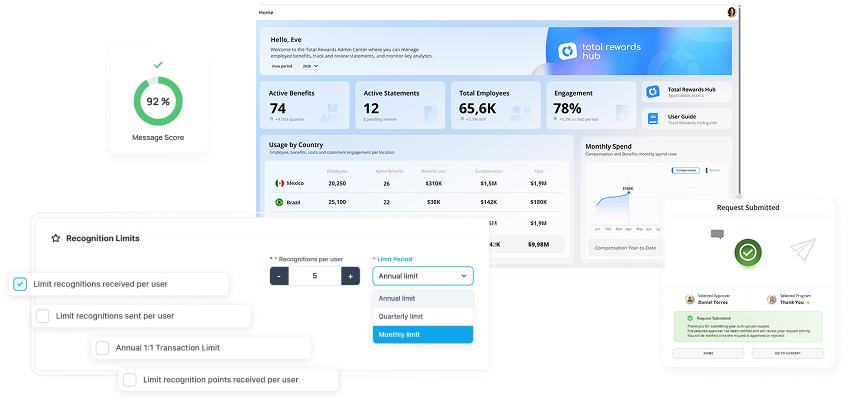


Enterprise-scale recognition, rewards, and communication no longer have to trade off against writing confidence, language, timing, visibility, or access. This release closes those gaps, bringing Semos Cloud's People and Culture Intelligence platform one step closer to a truly global and inclusive employee experience.
The new capabilities include:
- Relationship-aware AI drafts personalized recognition messages using employee context and recognition history.
- Inline translation makes every recognition message instantly readable in each employee's preferred language.
- Bulk recognition lets managers recognize hundreds of employees with a single upload.
- Flexible recognition limits help sustain recognition while keeping budgets under control.
- Total Rewards Hub Admin Overview delivers instant program insights with real-time dashboards and trends.
- Communication & Listening feed redesign brings important updates, surveys, and announcements to the forefront.
- Self-signup gives non-SSO and deskless employees secure access without IT support.
A message written in Tokyo used to lose something by the time it reached a colleague in Warsaw. Not the intent, that always came through, but the meaning. A nuance, a joke, a specific word chosen for a specific reason, flattened by a language barrier the sender never even saw. Multiply that across a global workforce, and you get a recognition program that works beautifully in English and quietly excludes everyone else.
That gap sat at the center of our Q2 2026 work, and it pointed to something bigger. Across the Recognition & Rewards, Total Rewards, and Communication & Listening modules of our People and Culture Intelligence platform, we saw the same opportunity: organizations had built real recognition and rewards programs, and we could make them work harder for every employee, everywhere. Give someone the right words to start with. Let a message scale from one person to hundreds. Keep a budget flowing all year instead of front-loading it in Q1. Turn a dashboard into an instant read instead of a Sunday export. Open the door for the employee who's never had a corporate email to walk through it.
This release is about pushing people experience further toward that global standard, wherever the next opportunity to close the distance shows up, in recognition, in rewards, or in the conversations that hold a workforce together.
What we delivered
Product innovations designed to make every employee experience simpler, smarter, and more inclusive:
- Give every employee a natural starting point for recognition. Relationship-aware AI drafts messages based on who's sending, who's receiving, their working relationship, and recent recognition history.
- Make every message land in the reader's own language. Inline, one-click translation of recognition posts directly in the social feed, with smart caching so nothing is translated twice.
- Let one person recognize one person, or five hundred. Bulk recognition turns a file upload into hundreds of individual, auditable recognition messages.
- Keep recognition flowing all year, not just in January. Flexible annual, quarterly, and monthly limits replace the single lump-sum allocation.
- Show Total Rewards admins what's working, the moment they log in. A redesigned Admin Overview dashboard replaces manual exports with automatic year-over-year trends.
- Put the content employees actually need in front of them first. A new hero carousel reorganizes the Communication & Listening feed around what matters most.
- Open the door for employees who've never had one. Self-signup via a personalized link brings non-SSO and deskless employees onto the platform for the first time.
AI writing, sharper: Turning "I don't know what to say" into "sent"
Picture the moment right before recognition happens: someone knows a colleague did something worth acknowledging, cares enough to say so, and still ends up staring at an empty text box, unsure how to put it into words that match how they actually feel. That hesitation, not a lack of care, is usually what stands between a recognition sent and a recognition never written.
%20(1).png)
"Write it for me" has always been there to help with that first draft. This release elevates it with real context. The AI now knows who's sending the message, who's receiving it, their reporting relationship, their location, and how recently recognition has passed between them, and uses all of that to produce a draft that actually fits the two people in the conversation. An employee who has never quite known how to phrase appreciation gets a starting point that already sounds like something a real colleague would say about a real contribution, protected by an MQI score held above 85% so messages stay individual rather than templated.
A global insurance and reinsurance broker, with recognition programs spanning offices on nearly every continent, has made "Write it for me" the default starting point for new managers, not just a fallback for people who struggle with words, precisely because the first message someone sends tends to set the habit for every one after it.
Bulk Recognition: From a routed request to a single upload, recognizing 200 people as easily as one
Some of the most meaningful recognition moments happen at scale. A product ships. A quarter closes. A cross-functional team of contributors, some of whom rarely get visibility, made it happen. The instinct to recognize everyone involved is there. What's usually missing is a fast way to act on it.
.png)
Bulk recognition removes the bottleneck between that instinct and the send button. A team lead who just shipped a feature with 50 people involved can upload a file and issue every recognition themselves, rather than routing the request through an administrator and waiting. Assuming roughly 3 minutes to write and send each individual recognition, a manual approach to acknowledging that same 50-person team could take well over two hours; with bulk recognition, it takes about 5 minutes, cutting the effort by more than 95%. The full approval workflow, status tracking, and audit trail travel with every bulk request, so speed doesn't come at the cost of governance.
Recognizing one person and recognizing two hundred people now takes the same amount of effort: none of it wasted, and none of it delayed by a queue. At a major retail, entertainment, and lifestyle conglomerate across the Middle East, store and cinema managers now submit their own post-campaign bulk recognition requests straight from the app, instead of routing them through an HR admin days after the moment that prompted them has already passed.
Flexible Recognition Limits: Keeping recognition consistent without losing budget control
Even well-designed recognition programs run into a specific, well-documented budget problem: a single annual allocation behaves like a use-it-or-lose-it pool, so spending gets front-loaded early out of caution about running out, and once it's gone, recognition stops until the next cycle. That drop-off matters more than it might seem: among employees who receive feedback and recognition from their manager at least once a week, 61% are engaged, compared with only 38% of those who receive that same feedback but recognition less often (Gallup). Frequency isn't a nice-to-have, it's a large part of what makes recognition actually work.
%20(1)%20(1)%20(1).png)
Flexible recognition limits solve this directly. Administrators reset budgets annually, quarterly, or monthly instead of relying on one lump sum. An administrator running a peer-to-peer program can configure monthly limits so every employee gets a fresh allocation each month, with the remaining balance visible in both the application and Copilot. Recognition stops being a January phenomenon and becomes a habit that holds up in October, which is exactly the pattern the data above rewards.
One of Latin America's largest bottling and beverage manufacturers moved its plant-floor recognition program to monthly resets after realizing its annual budget was on pace to be exhausted before the end of Q1 across its manufacturing sites.
Auto-Translation: Breaking language barriers to connect global teams
Getting a message written is only half the problem for a global workforce. The other half is what happens after it's sent, when the person reading it doesn't share a language with the person who wrote it. That gap has a real cost: even companies with recognition programs live in every region they operate in still see recognition stay concentrated in the home market, with 70%+ of recognition staying local at most multi-regional companies, and only a rare handful ever reach genuine cross-border flow. Language and cultural comfort are a big part of why: writing recognition in a second language creates hesitation long before it creates a message.
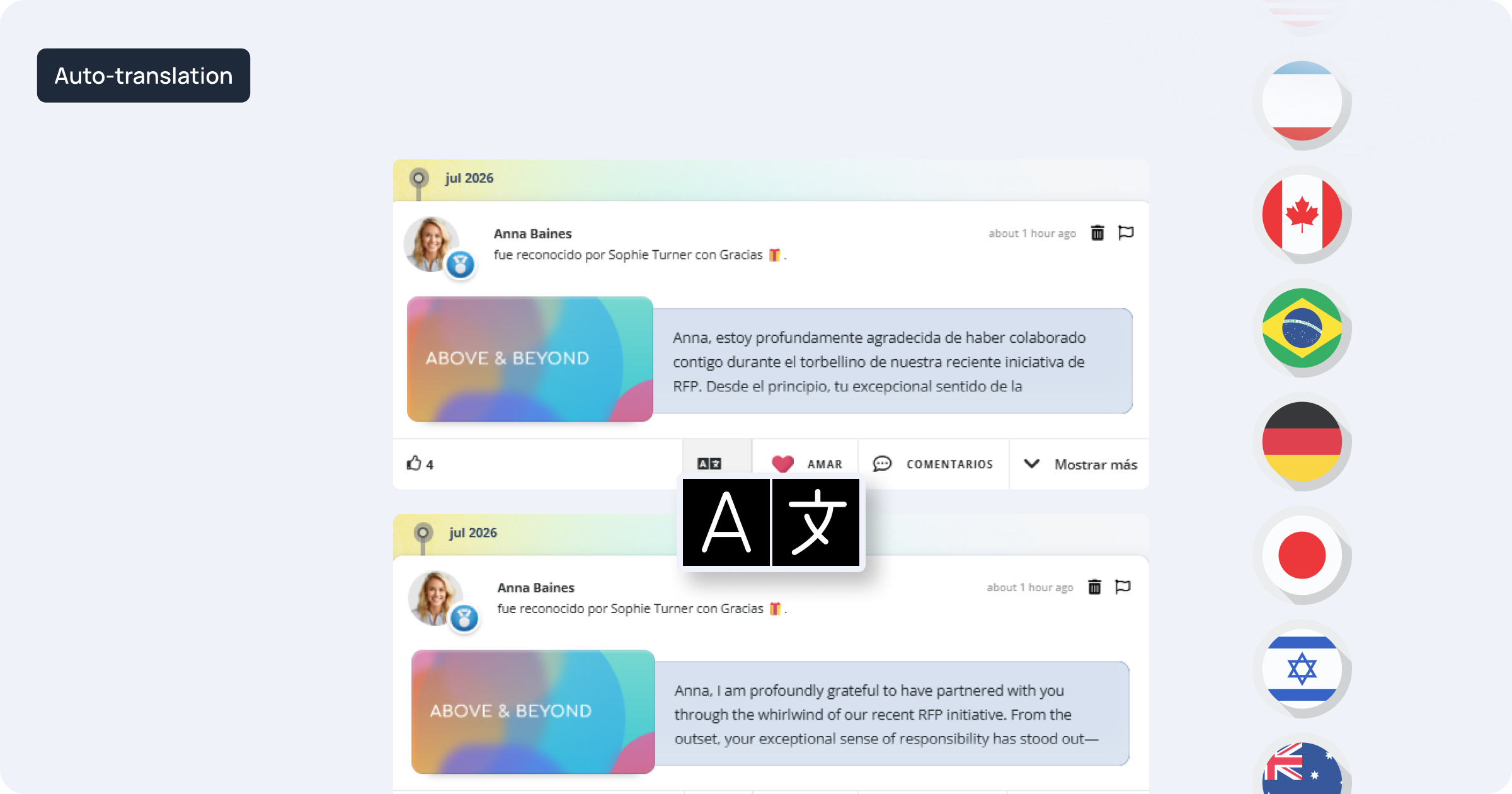
This is where auto-translation does its work, and it's the capability we built this release around. A manager posts recognition in Japanese. A teammate in Warsaw opens the feed and reads it in Polish, instantly, in the same view, without a page reload and without ever leaving the post.
What that means in practice is that recognition stops being something that works best in the language the platform happens to default to. A company with teams across Tokyo, Warsaw, São Paulo, and Nairobi can run one recognition program, not four parallel ones held together with manual workarounds, and every employee reads appreciation the way it was meant to land: in their own words, on the first read, without friction.
Companies with strong cross-border recognition report a 40% higher likelihood of proactive collaboration across geographies, and removing the language barrier tends to show up in the numbers on both sides of the message, more recognition actually gets sent once people aren't hesitating over how it will read in translation, and employees who can fully understand the recognition they receive engage with it, and with their work, more than employees who only get the gist.
One of the world's largest professional services firms, with employees and client teams spread across more than 150 countries, now sees auto-translation as the single most-used feature on its social feed.
Total Rewards Hub Admin Overview: Identifying risks before they impact engagement and spend
HR teams report that manual data input is the single biggest obstacle to hitting reporting deadlines, with data entry and manual adjustments alone consuming roughly 80% of the time spent on HR reporting cycles combined (NTT DATA). For a Total Rewards team running a quarterly cycle, that typically translates into days of an administrator's time spent just assembling the report, before anyone can even start deciding what to do about what it shows.
%20(1).png)
The real cost is what happens during the gap while the report is being built. A country with a quietly declining statement read rate, a benefit category nobody redeems, spend drifting off plan: none of that surfaces until the export is finished and reconciled, which means the earliest an administrator can act is whenever the next report happens to be due. By the time a risk becomes visible, it's often already been running unnoticed for a full quarter, and whatever it was costing, engagement, retention, budget, has been accumulating the whole time.
The redesigned Total Rewards Admin Overview closes that gap. It's a single, role-scoped dashboard that shows year-over-year trends in active benefits, statements, employees, and platform engagement the moment an administrator logs in, backed by country-level usage, monthly spend, benefits-by-category, and statement read-rate data. Picture an administrator opening the dashboard at the start of a new quarter: engagement is up year-over-year, but statement read rates in two countries are flagged in red before any report has been exported. They know exactly where to focus, in the time it used to take just to open the spreadsheet, and they're finding out in week one of the quarter instead of week twelve, while there's still a full quarter left to actually fix it.
An energy sector customer's Total Rewards team has replaced its quarterly reporting cycle with a Monday-morning look at the Admin Overview instead.
Employee Communications & Listening Feed Redesign: Making important messages impossible to miss
A cluttered communication feed has a real cost: the survey that needed a response, the announcement that mattered, the pinned update from leadership, all scrolled past because nothing separated them from routine content.
.png)
The redesigned Communication & Listening feed solves this with a new hero carousel that surfaces the most important or promoted content, active surveys, and pinned communications the moment an employee opens the platform, with no configuration required from admins. The underlying logic hasn't changed. What's changed is that employees now see what matters first, instead of finding it eventually.
A healthcare customer with a large frontline population saw survey response rates improve within weeks of the redesign going live, without changing a single survey.
Self-Signup: Expanding participation beyond the corporate inbox
None of the above matters if an employee can't get onto the platform in the first place. Deskless and non-SSO employees, contractors, frontline teams, have historically been the population every recognition and communication rollout leaves stranded, not by design, but because account provisioning assumed a corporate email that not everyone has.
.png)
Self-signup via a personalized link removes that assumption. Each employee receives a unique invitation link by SMS or email, sets their own credentials, and is active on the platform immediately, on web or mobile, with no IT ticket and no manual account setup.
For a company with a large frontline or deskless population, this is the difference between a recognition or communication that reaches headquarters and one that reaches everyone.
A large health and human services provider in the US, where the majority of its workforce are direct-support professionals without a corporate email address, onboarded thousands of frontline employees in its first week live, using nothing but a personalized SMS link.
The whole experience, without barriers
What ties these seven capabilities together is a single idea: enterprise scale shouldn't come at the cost of writing confidence, language, timing, visibility, clutter, or access. Each one closes a different distance, and together they add up to something bigger, inclusion, with outcomes organizations can actually measure:
- A message written in one language reaching someone in another, in their own words. Recognition participation grows because nobody's excluded by a language barrier.
- A team of two hundred acknowledged as easily as a team of two. The administrative time it takes to run a large-scale recognition moment drops from days to minutes.
- A budget that holds through December instead of running dry in Q1. Recognition stays consistent all year rather than spiking early and disappearing.
- A dashboard that tells an administrator the truth without a spreadsheet. A quarterly reporting cycle becomes a weekly five-minute check.
- A feed that shows employees what matters. Engagement rises with the surveys and announcements that used to get scrolled past.
- An employee without a corporate login, on the platform anyway. An entire deskless or frontline workforce enters a program that used to reach headquarters only.
That's what People and Culture Intelligence is built to do: connect the moments that make up recognition, rewards, and communication so that none of them depend on who's writing, what language they write in, how big the team is, or how someone happened to be set up on day one, and so the impact of each one shows up where it counts: participation, retention, and time saved.
[cta]
Common questions (and answers) about this release
1. Is auto-translation available for every language, and does it translate the whole feed or just individual messages?
Auto-translation works inline across the social feed, so any post, not just the ones written to you personally, can be read in your own language with one click. Session preferences are remembered across logins, and the same post is never re-translated twice thanks to smart caching.
2. Does "Write it for me" replace human recognition with AI-generated messages?
No. The AI drafts a starting point based on the sender, recipient, their relationship, and recent recognition history, but the goal is to help people express appreciation they already feel, not automate it. An MQI uniqueness score above 85% keeps messages individual rather than templated.
3. How does bulk recognition maintain governance at scale?
Every bulk recognition request, whether it covers one person or hundreds, goes through the same full approval workflow, status tracking, and audit trail as an individual recognition. Speed doesn't come at the cost of oversight.
4. Can administrators choose how often recognition budgets reset?
Yes. Flexible recognition limits let administrators configure resets annually, quarterly, or monthly instead of relying on a single annual allocation, with the remaining balance visible to employees in both the application and Copilot.
5. Do employees need a corporate email or SSO account to use the platform?
No. Self-signup via a personalized link lets any employee, including deskless and non-SSO workers, create their own account through a link sent by SMS or email, active immediately on web or mobile with no IT ticket required.

Ready to unify your people programs?
Stop running recognition, rewards, communications, and development in silos. See how Semos Cloud brings it all together in one AI-powered platform, built for enterprise, certified for compliance, and proven at scale.