


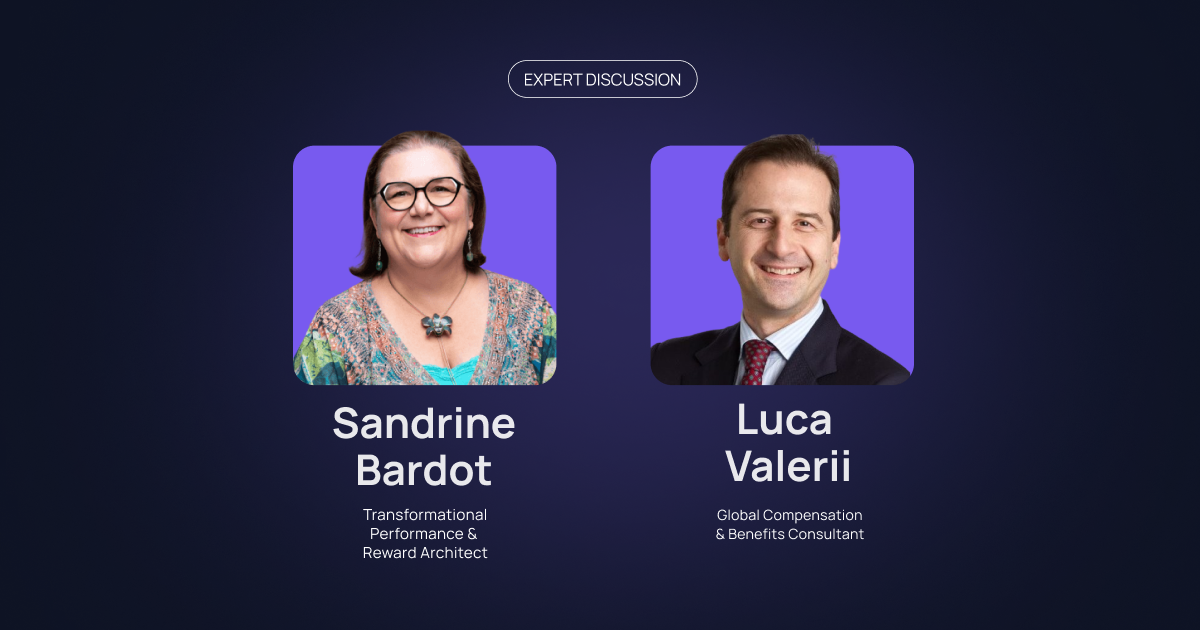
This article is based on Semos Cloud's expert discussion with Sandrine Bardot and Luca Valerii on pay conversations, annual reviews, and manager readiness.
Watch the full expert discussion.
A manager sits down with someone on their team. The employee has already looked up the salary range now posted on the job ad for their own role, and they lead with the obvious question: the range goes higher than what I make, so why am I here?
The manager has the number they were handed. What they do not have is a way to explain it. So they reach for something reassuring, and the conversation starts to slide.
This is where pay transparency gets decided. Not in the policy, the ranges spreadsheet, or the briefing deck, but in the few minutes where one manager explains why an employee got 2 percent, why a colleague got more, and what would change that next year. The employee leaves that room having decided whether the process is fair.
Most transparency work goes into the parts that feel like progress: cleaning the data, publishing the ranges, writing the policy, briefing the managers. That work is necessary and it is not where the system gets tested. The deadline is a document problem. The day after is a conversation problem, and the two need different preparation.
"It's not just a communication event when you have this paid conversation, it's when your governance, your reward governance, becomes real through one manager in one room in one conversation." - Sandrine Bardot
Watch Sandrine make the case that pay governance lives or dies in that single conversation:
It does not hold when the manager only has the number. In the discussion, Sandrine walked through the specific ways these conversations come apart, and they are worth taking one at a time, because each one points to a different gap in how organizations prepare.
The pay philosophy that never makes it into the room
Most companies have a pay philosophy. They pay for performance, or they pay to market, or they favor internal mobility. The words exist in a policy somewhere.
Sandrine's point is that the document is not the test. The test is whether the manager can turn that philosophy into an answer that is specific and credible for the one employee in front of them. If the manager does not understand how the organization actually approaches pay differentiation before they walk in, the explanation comes out sounding administrative instead of principled, and the employee stops believing the philosophy is real.
"If you cannot transfer, transform that philosophy into a governing behavior, it's just branding." - Sandrine Bardot
A better one-pager will not fix this. What fixes it is making sure the people having the conversation can connect a single decision back to the principle behind it. The Transparency Advantage playbook frames this as the manager's actual job: not to decide pay, but to explain decisions in a way that builds trust in the process. The pre-conversation diagnostic in the playbook tests exactly this, asking whether a manager can explain the logic using performance, role level, market position, and budget before they ever state an outcome.
The manager knows the number but cannot explain it
The second failure is more common and more damaging. The manager has the data. They know the rating, the increase, the budget movement. They just cannot explain how those factors produced this specific result.
That is the moment the employee starts testing the system. What mattered most here, performance or my position in the range? How did my results and the company's results interact? Where did judgment enter? When the manager cannot answer, the conversation runs into what Sandrine calls the black box, and trust erodes fast.
"Opacity, or the black box, as we call it sometimes, it's a big, big factor in which employees do not believe in the fairness of the process." - Sandrine Bardot
This is where the data problem sits underneath the conversation problem. Compensation history lives in one system, performance inputs in another, market data with the comp team, ranges in a spreadsheet, pay equity analysis somewhere the manager never sees. Ask a manager a simple "why am I here" question and the honest answer requires five systems and three specialists, so they improvise or defer. Total Rewards Hub exists to collapse that gap, giving managers real-time access to compensation context inside the systems they already use, so the explanation is available in the room rather than after it.
The playbook's five-step framework for annual reviews is built for this exact failure: ground the conversation in data, state the decision clearly, connect it to performance and market reality, acknowledge the emotion, then open the path forward. The sequence removes defensiveness before it starts, because the employee hears the context before the number.
[cta]
Every manager interprets the message differently
Give the same compensation cycle to a hundred managers and you can get a hundred conversations. One says too much. One says too little. One disowns the decision entirely.
"One manager says too much. Another says too little. A third one will distance themselves from the decision entirely. They will say, oh, no, HR decided that. I don't think there's a single HR person in this webinar who has not heard that." - Sandrine Bardot
The instinct behind "HR decided that" is usually kind. The manager wants to preserve the relationship, so they sound sympathetic: I agree this is disappointing, let's see if we can fix it next cycle. But the employee hears something the manager never intended. They hear that the manager does not own the decision, that HR is the obstacle, and that the outcome might be negotiable after the fact. A comment meant to soften the moment ends up doing more damage than silence.
Sandrine is blunt that this is not a communications-polish issue. It is a governance issue. Managers should not promise a future outcome the system cannot guarantee. They should not criticize HR or the structure. They should not send the employee off to "go ask HR yourself." Those are not personality quirks, they are evidence that the organization set no boundaries. And boundaries need consequences: if a manager promises a promotion the system cannot honor, that needs a conversation with the manager and their director, because the alternative is solving today's problem while manufacturing tomorrow's.
The playbook's language guidance turns these boundaries into usable lines. Instead of "HR made this call, not me," a manager has "our process is designed to make decisions consistently and fairly, and I can partner with HR on any follow-up." Instead of false hope, a concrete checkpoint with specific criteria. The goal is not a script. It is a set of phrases the manager can adapt without crossing a line they did not know was there.
The conversation explains the past but not the future
The last failure happens even when everything else goes right. The manager explained the decision, the criteria, the process. Then the employee asks the question that actually decides retention: what would move me up next year?
"They cannot explain the path forward. That's what the employees want to understand. They want to understand what progress looks like." - Sandrine Bardot
Here she is on why the path forward is the part employees are really listening for:
This is where the employee figures out whether growth is real or the system is closed. A good answer separates what the employee can influence from what they cannot, and makes the realistic path concrete. The playbook is direct that false hope is one of the fastest ways to damage trust, which is why its promotion and growth language replaces "just keep doing what you're doing" and "maybe next year" with specifics: here is what readiness for the next level looks like, here is what we would revisit and when.
The four-question readiness test
Sandrine offered HR a fast diagnostic. Before review season, check whether your managers can answer the hardest pay questions in a way that is accurate, consistent, clear, and defensible:
- Why this increase or bonus, and compared to whom?
- What factors mattered most in this decision?
- Who had input into it?
- What would I need to change to get a different outcome next time?
If managers cannot answer those four cleanly, the problem is not communication. It is operating readiness, and the time to fix it is before the cycle pressure starts, not in a last-minute briefing.
Transparency raises the stakes on all four
Everything above is already true today. The EU Pay Transparency Directive makes it sharper. Luca Valerii laid out what changes: companies will have to publish pay ranges in job ads, they will no longer be able to ask candidates for current salary, and employees gain a right to information about average pay for equal or equivalent work. Each of those sends more informed people into the same annual conversation with better questions.
Luca's warning to HR teams was about the gap between being ready on paper and being ready in practice. One compensation leader told him they were ready because the tools, calculations, and day-one communications were done. His response was that they were only at the start.
"We are ready, technically. But we are not really culturally." - Luca Valerii
Luca explains why being ready on paper is not the same as being ready:
Technical readiness, in his words, is the minimum. It gets a company to the deadline. The investment in cultural change, communication, and manager training is what determines what happens the day after, and that cannot be switched on like a report format.
Luca also pushed back on the fear driving some of this. Most companies already run on equitable mechanics. A merit matrix that weighs market positioning, internal equity, and performance is pay equity in practice, applied for years. His advice was not to hide that work. A company that says "we have applied these criteria for a long time, and now we are making them more visible" lands very differently than one that appears to be inventing fairness because a law forced it.
Annual reviews become the stress test
Once employees know their rights, the questions will not stay spread evenly across the year. Sandrine expects them to concentrate at the salary review. That is when performance, pay, progression, and fairness all meet in one conversation, and now public ranges, the right to information, and rising pay-equity awareness pile onto a moment that was already loaded.
So the annual review stops being a private exchange and becomes the test of the whole compensation system. Can similar cases be explained similarly across hundreds of managers? Can each manager describe which factors mattered and separate what the employee controls from what they do not? Can they acknowledge a hard outcome without undermining HR or the company? If not, the gap is operating readiness, and review season is where it shows.
Exceptions are where trust quietly breaks
Every system has exceptions. Scarce skills, retention pressure, market movement, legacy structures, acquisitions, roles that outgrow their band. Sandrine's position is that exceptions themselves are fine. Unmanaged exceptions are the problem.
"Exceptions are not necessarily bad. But exceptions need to remain that, exceptions." - Sandrine Bardot
Her rule has teeth. An exception should stay under roughly 5 percent of cases, should be governed by consistent rules rather than one manager handing out 30 percent while another gives 5, and should be documented and justified. When the same exception keeps recurring, that is a signal to change the rule, not to keep granting one-offs. She gave the example of a geologist role in oil and gas where scarcity justifies a defined super-maximum above the normal band ceiling, a documented rule the organization can defend, not a favor buried in someone's inbox.
This connects back to a structural warning. If a salary range is 12 years out of date, no amount of manager coaching will make it defensible. Sandrine has seen structures untouched for over a decade while the market moved underneath them, and the usual workarounds, overpaying against the band or overgrading the hire, create problems in both directions. When ranges fall behind, the fix is to put a business case to leadership for fresh market data, the same way a company funds maintenance on any other aging tool.
Employees trust the manager first
One point from the discussion was not regulatory at all. Employees do not experience pay transparency through a PDF or an intranet page. They experience it through the person who answers their question.
"The first source of information that employees trust about any question that they have about the company, but in particular pay information, is their line managers. It's not HR, it's not your intranet." - Sandrine Bardot
Sandrine on why the manager, not HR, is the source employees actually believe:
Yet companies usually communicate in the wrong order. Leadership gets the story, legal gets the risk, HR gets the implementation plan, and managers get something late, once the cycle is moving and the questions are about to land. Luca's recommendation reverses that. Prepare the manager first, then have them proactively meet their teams, even to admit that compensation is not an exact science and that history, acquisitions, and different career paths produce real differences. A manager who names that openly, and commits to closing gaps where resources allow, holds more trust than one who waits to be cornered.
This is also why Luca and his teams are training HR business partners before managers in their own EU rollouts. The HRBPs are the ones who will help managers interpret the logic, and reward specialists are not always the strongest communicators. The generalists who understand employee psychology are the bridge.
What HR should build before review season
The practical work is specific. Start from the hardest questions employees will ask, then test whether managers can answer them accurately, consistently, clearly, and defensibly. Where they cannot, fix the operating model before the cycle starts:
- Give managers the story behind the number, not just the number.
- Prepare HRBPs first, since they will coach the managers.
- Define what managers can say, what they must not promise, and what they must escalate.
- Connect pay conversations to reliable data instead of scattered spreadsheets and memory.
- Treat exceptions as governed, documented decisions, not one-off fixes.
- Give managers adaptable language, not rigid scripts they will abandon.
- Keep educating managers after launch, because this becomes part of how the company operates.
The Transparency Advantage, created with Sandrine Bardot, makes that preparation concrete. It covers annual salary reviews, promotion conversations, and the difficult "I deserve more" moment, with frameworks, data checklists, and the do-say and do-not-say language managers need before the conversation starts.
Pay transparency is a running state, not a launch
The deadline matters. The day after matters more. Once employees can ask better questions, they keep asking. Once ranges are visible, comparisons keep happening. Once criteria are published, employees expect the criteria to match their experience.
Sandrine closed on this image:
"You don't just focus on the wedding day, you need to focus on the length of the marriage." - Sandrine Bardot
Sandrine's closing point on why transparency is a long-term commitment, not a launch date:
Organizations that treat transparency as a one-time compliance project will keep finding new places where the story breaks. The ones that treat it as an operating model will be ready for the questions that come next. Two layers carry that: Total Rewards Hub gets the data and context into the room, and the playbook helps managers use it without eroding trust. Transparency only works when the system can be explained, and that explaining happens one manager, one room, one conversation at a time.
Download The Transparency Advantage: A Manager's Guide to Strategic Pay Conversations, developed by Semos Cloud in collaboration with Sandrine Bardot.


Explore related articles


Ready to unify your people programs?
Stop running recognition, rewards, communications, and development in silos. See how Semos Cloud brings it all together in one AI-powered platform, built for enterprise, certified for compliance, and proven at scale.