





- The EU Pay Transparency Directive transposition deadline was June 7, 2026. As of mid-June, only four member states (Italy, Slovakia, Lithuania, Malta) have full implementing law in force. Most major economies are behind.
- 17 U.S. states plus Washington, D.C. now have active pay transparency laws, layering an additional compliance map for multinational employers.
- Pay transparency is the visible question. Four operational layers sit underneath it: job architecture, data consolidation, governance and communication, and manager capability. They have to land together.
- 37% of organizations name manager inability to explain pay as their single biggest transparency hurdle.
- The four layers stop being four projects when they live inside one platform purpose-built for the work. Total Rewards Hub, built on SAP BAIP, is the Semos Cloud platform for that.
The regulatory picture as of late June 2026
The EU Pay Transparency Directive's transposition deadline was June 7, 2026. As of mid-June, only four member states have full implementing law in force: Italy, Slovakia, Lithuania, and Malta. A handful more have partial transposition. The rest, including Germany, France, Spain, and the Netherlands, have either missed the deadline outright or set domestic entry-into-force dates into 2027. The result is a patchwork that multinational employers now have to manage country by country, with different definitions of "category of workers," different reporting cadences, and different employee information rights depending on where their headcount sits.
On the other side of the Atlantic, 17 U.S. states plus Washington, D.C. have active pay transparency laws of their own. The Directive is in force. The operational work underneath the headlines is more complex than the headline reporting suggests.
Three patterns from Paris
Three patterns stood out across the day's conversations with Total Rewards and HR leaders.
Pattern 1: Awareness is high. Operational specifics are still low.
Total Rewards and HR teams know the Directive matters. Fewer are clear on exactly what it requires of their organization, when, and in what format. Internal legal teams have not finished translating obligations for compensation, and the practical question, "what do I publish, to whom, and by when," still has no clean answer.
Pattern 2: Three jobs at once, with no system that connects them.
Manage the right data. Follow the compliance rules. Communicate the answer to employees. Most enterprises are running these three on separate tracks.
Pay data lives in payroll. Job architecture lives in the HCM. Benefits often live in spreadsheets or with a third-party vendor. Equity sits with a separate provider entirely. The moment an employee asks "why am I paid this?", the answer requires pulling data from systems that were never designed to talk to each other, into a conversation a line manager was never trained to have.
"In Paris, every conversation came back to the same thing. Total Rewards leaders want one platform that handles all four layers, inside the SuccessFactors environment they already run."
- Mile Prodanov, Head of Sales, Semos Cloud
Pattern 3: Total Rewards is the function leading this work, often alone.
Compensation specialists led the conversations in Paris. Total Rewards is being asked to drive a compliance moment that touches data engineering, legal interpretation, communications design, and manager enablement. It is the right function to lead it. It is also the function least resourced to do it alone.
[cta]
The four unsolved layers underneath pay transparency
Pay transparency is the visible question. Underneath sit four layers of operational work most organizations have not finished. Each layer can be tackled in isolation. None deliver compliant, trusted transparency on their own. They have to land together.
1. Job architecture and operating model. Most organizations have job titles and pay bands. Far fewer have a current operating model around them, with rules for exceptions, manager accountability, and a review cycle. Without that, transparency runs into inconsistencies the first time an employee asks "why" and the system has no answer.
2. Data consolidation. The HCM is rarely the single source of truth in practice. Payroll runs in another system. Benefits live in spreadsheets. Equity sits with a separate vendor. Until those streams are unified at the employee level, every transparency statement is one follow-up question away from breaking.
3. Governance and communication. Who can talk about pay. Who responds to information requests. What gets disclosed in a job advert versus internally. These policies need to exist before the first transparency conversation lands. Most organizations are still drafting them.
4. Manager capability. Pay transparency holds or fails at the line manager's desk. 37% of organizations named manager inability to explain pay as their single biggest transparency hurdle. Managers need data, context, and a clear script for the conversation.
“The real challenge when it comes to pay transparency is when it moves out of HR and into the hands of line managers. They're expected to have sudden, open, honest conversations about pay with their teams."
— Sophie Janke, Implementation Consultant, gradar
From the Semos Cloud Pay Transparency Panel hosted by Filip Misovski
Where Total Rewards Hub fits
Total Rewards Hub is the Semos Cloud platform purpose-built for this work. Built on SAP BAIP, it brings five capabilities together to handle all four layers:
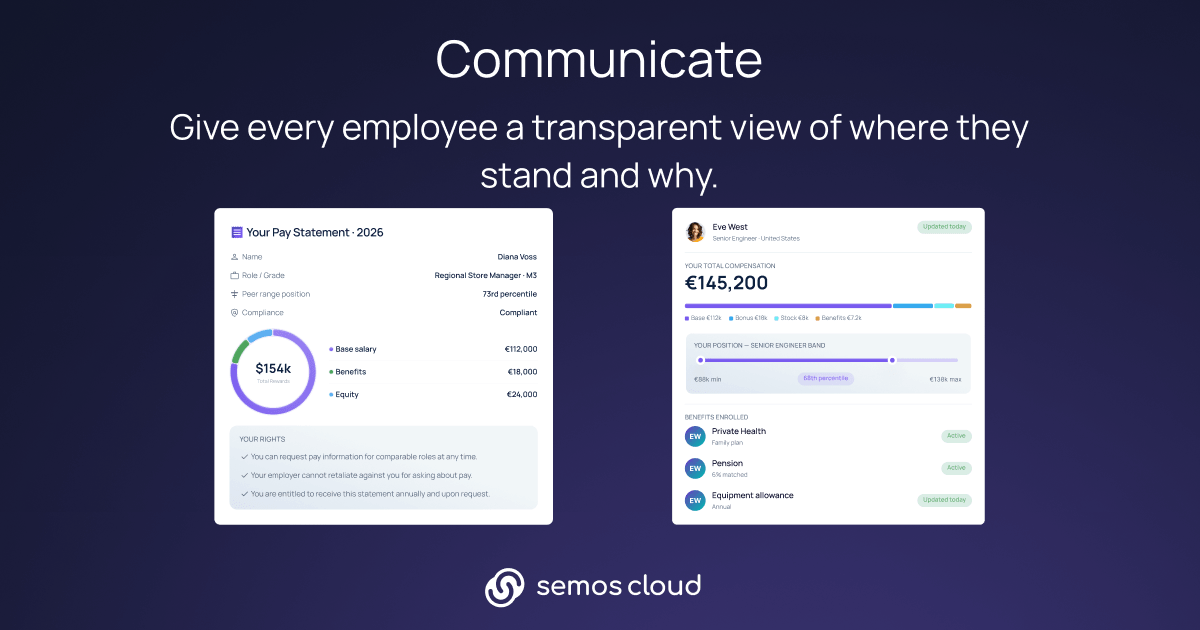
- Employee Rewards Portal. A unified view of salary, bonuses, equity, benefits, and incentives in one place, with consumer-grade UX.
- Benefits Management. Flexible benefits catalog, built-in communications, utilization analytics, market benchmarks.
- Pay Equity and Transparency. Regression-based gap analysis, governed remediation workflows with safeguards, transparency statement generation per employee.
- Compensation Analytics. Budget tracking, market competitiveness, segmented reporting at the granularity the Directive expects.
- Manager Enablement. A Pay Transparency Agent, that gives line managers the data and the language for the pay conversation, inside their daily workflow.
[cta-2]
What the Paris conversations confirmed
Total Rewards leaders are past the demo stage. They are looking for someone to tell them whether the four layers underneath pay transparency are actually solvable inside the systems they already own.
The honest answer is yes, when those layers sit inside one platform built on SAP BAIP and connected to SuccessFactors. The harder answer is that most enterprises are still running pay, benefits, and equity in separate tools, with manager enablement added as an afterthought. Bringing those layers together is the work for the rest of 2026.

What Total Rewards leaders should do this quarter
Four moves, in order.
1. Map your actual data sources. Not the system you think holds pay, benefits, equity, and grade information. The one that actually does. The distance between the two is usually the project.
2. Get country-level legal clarity. The Directive sets minimum requirements. Each EU country is transposing on its own timeline and with its own definitions. Where you operate determines what you have to comply with, and by when. Internal legal needs to surface that map to Total Rewards now.
3. Build the manager script. Most enterprises are designing the report and leaving the conversation to line managers to improvise. Equip your managers with the data and the language to handle the pay question when it comes up, inside the workflow they already use.
4. Pick a platform that solves all four layers. Single-purpose pay equity tools, benefits portals, and analytics dashboards each solve a slice. The compliance moment requires all four layers in one place, inside the system your enterprise already runs.
For enterprises building this on SAP SuccessFactors specifically, our Guide to Maximizing SAP SuccessFactors Integration goes into the patterns that hold up at scale. It covers what to keep inside SuccessFactors as the system of record, where the People and Culture Intelligence layer extends it, how Total Rewards data flows into a unified employee view, and the integration architecture choices that turn quarterly compliance reporting into routine work for HRIS rather than a quarterly fire drill
[cta-3]
Questions we heard in Paris (and our answers)
Where do we actually start when we run pay in multiple EU countries?
Most Total Rewards leaders start with a country-by-country map: what each local transposition says (or is expected to say), which categories of workers it defines, and which reporting cadences apply to your headcount there. Legal clarity per country comes first, then the operational plan follows from it.
Our comp data is in five systems. How do we get to one transparency statement?
Data consolidation is one of the four operational layers underneath pay transparency, and most enterprises are still working through it. Start with a system inventory: what actually holds base salary, bonus, equity, benefits, and local pay structures today, versus what you think holds it. The distance between the two is usually the project. From there, a unified employee view can be assembled inside your existing stack without waiting for a full data warehouse rebuild.
Do we wait for our country to transpose before we start?
Waiting leaves you exposed on two fronts. Candidate-facing pay disclosure obligations are already being applied in several countries even without full transposition, and internal readiness (data, job architecture, manager enablement) takes months to build regardless of when local law lands. The safer path is to start on the operational layers underneath, so the report is ready when the country-specific rules land.
What do we tell managers when the pay conversation script is not finalized?
The report is where most enterprises are putting their planning energy. The conversation with the employee is where transparency actually holds or fails, and manager enablement is one of the four layers most organizations have not finished. The practical move is to give managers three things now: the data behind the pay decision, the context that explains it (band position, budget headroom, role scope), and the language to walk through both. A Pay Transparency Agent inside Total Rewards Hub gives managers that view in their daily workflow.
Can Total Rewards Hub handle all four layers, or just parts of it?
Total Rewards Hub is built on SAP BAIP and covers all four layers as one platform: pay equity and transparency (regression-based gap analysis, remediation workflows, transparency statement generation per employee), benefits management, compensation analytics, and manager enablement through a Pay Transparency Agent. The Employee Rewards Portal sits on top as the employee-facing unified view. Our Guide to Maximizing SAP SuccessFactors walks through how it fits inside a SuccessFactors environment.
Explore related articles



Ready to unify your people programs?
Stop running recognition, rewards, communications, and development in silos. See how Semos Cloud brings it all together in one AI-powered platform, built for enterprise, certified for compliance, and proven at scale.