



- A total rewards statement and total rewards visibility aren't the same thing, even though most organizations treat them as interchangeable.
Someone on our team recently asked a Total Rewards leader how much visibility employees had into their total rewards. The answer described the statement: when it goes out and what it covers. That answer was reasonable. In the standard enterprise operating model, annual disclosure was the mechanism for communicating rewards, so the document and the capability were genuinely the same thing.
The two have since come apart. Employees make decisions about pay, benefits, and mobility on their own timeline now, and they expect reward information to be there, and to make sense, when they arrive.
The total rewards statement was built for a different job
A total rewards statement is a periodic disclosure instrument. It summarizes what an employee received over a defined period, and it does that job well. Responsibility for employee understanding was added to it later, and the design never changed to carry the extra weight.
For most organizations the annual statement is the mechanism. It is the one thing that carries reward information to employees, once a year. LIMRA's 2025 BEAT Study found that 42% of employees say they receive one, and LIMRA links that figure directly to how well employees understand and value their benefits. When the mechanism reaches fewer than half the workforce, everything built on top of it inherits that limit.
Total rewards visibility has four levels, and a statement reaches one
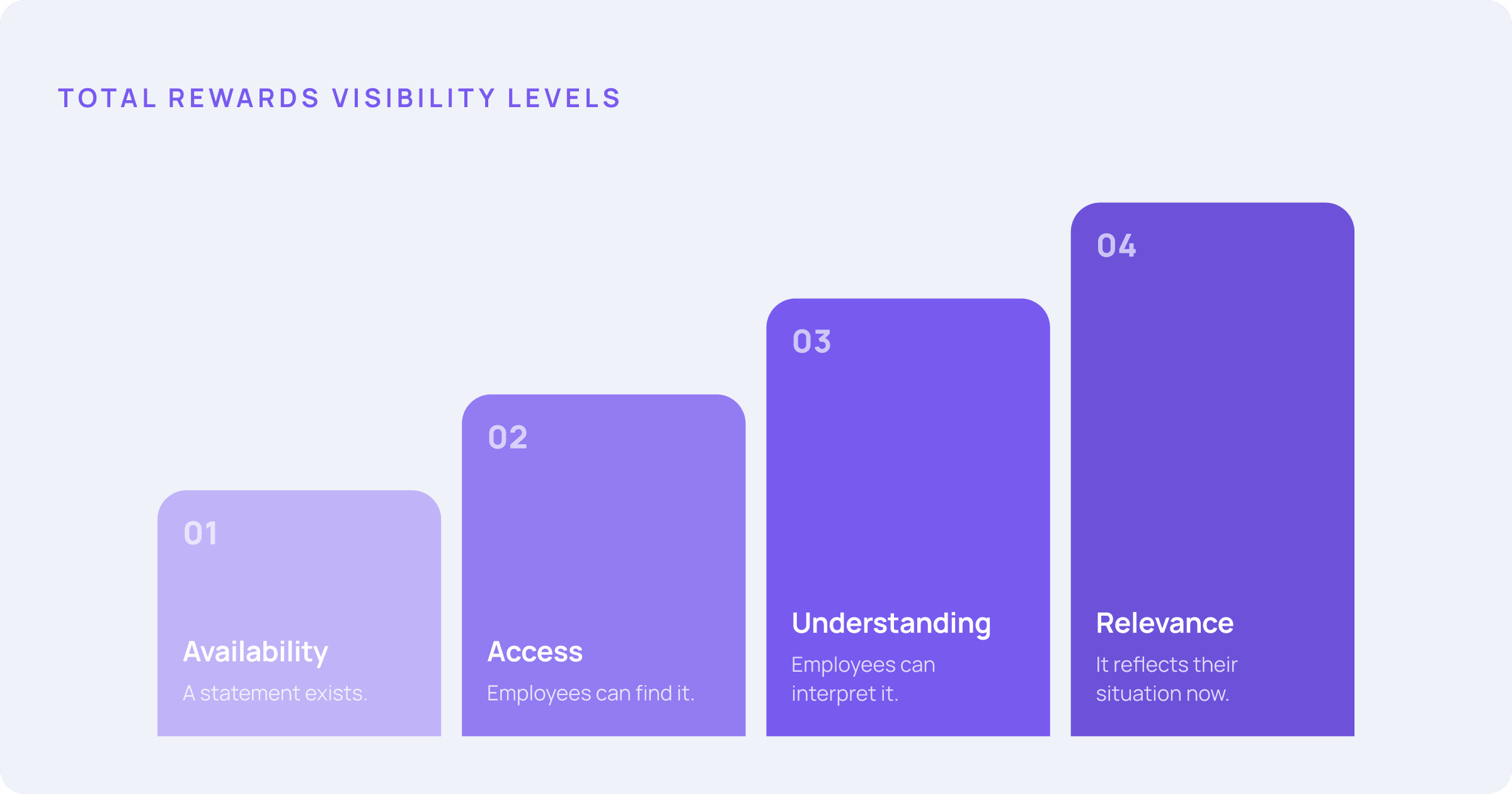
When a Total Rewards team is asked whether employees have visibility, the answer usually comes back as a yes or a no about a document. But the question "Do we have total rewards visibility?" bundles four distinct dimensions:
- Availability. A statement exists.
- Access. Employees can find it.
- Understanding. Employees can interpret what they receive.
- Relevance. The information reflects their situation now.
A statement answers the first. A portal usually answers the second. Understanding and relevance are different problems, and answering the first two does not produce them.
Two mechanics keep them apart. The first is timing: a statement is accurate on the day it is issued, while compensation keeps moving afterward through raises, vesting events, and newly available eligibility, so the document begins aging immediately. The second is that feeling informed and feeling satisfied are two different outcomes. WTW's December 2025 data found that employees who feel informed about their benefits rose to 84% from 77%, while satisfaction fell to 61% from 66%. Both numbers moved, in opposite directions. Satisfaction responds to whether rewards are valuable, usable, relevant, and fair, and to the quality of the experience around them. Volume of information is a different variable.
The structural shift behind total rewards visibility
Total rewards visibility is structural. It runs on continuous access rather than an annual cycle, and on one view spanning compensation, benefits, incentives, and recognition. Communication follows events in an employee's actual record: a promotion, a vesting date, a new eligibility, an enrollment window. And every number arrives with some explanation of why it is what it is.
Reward elements behave differently, and visibility has to respect that. Base pay is stable. A bonus may be a target or an actual payout. Equity changes value over time. A benefit can be described by what it costs the employer or by what it is worth to the employee. Recognition is usually left out of the total rewards picture altogether, though it shapes how employees experience their rewards even when it is not part of formal compensation. A single view has to hold all of that without flattening it into one number.
The value of all this shows up at decision moments: an employee weighing a competing offer, a manager preparing for a pay conversation, a promotion, a new eligibility, a return from parental leave, an enrollment window, a question about internal mobility. What matters is whether an employee can understand their package at the moment a decision about pay, benefits, mobility, or retention is being made.
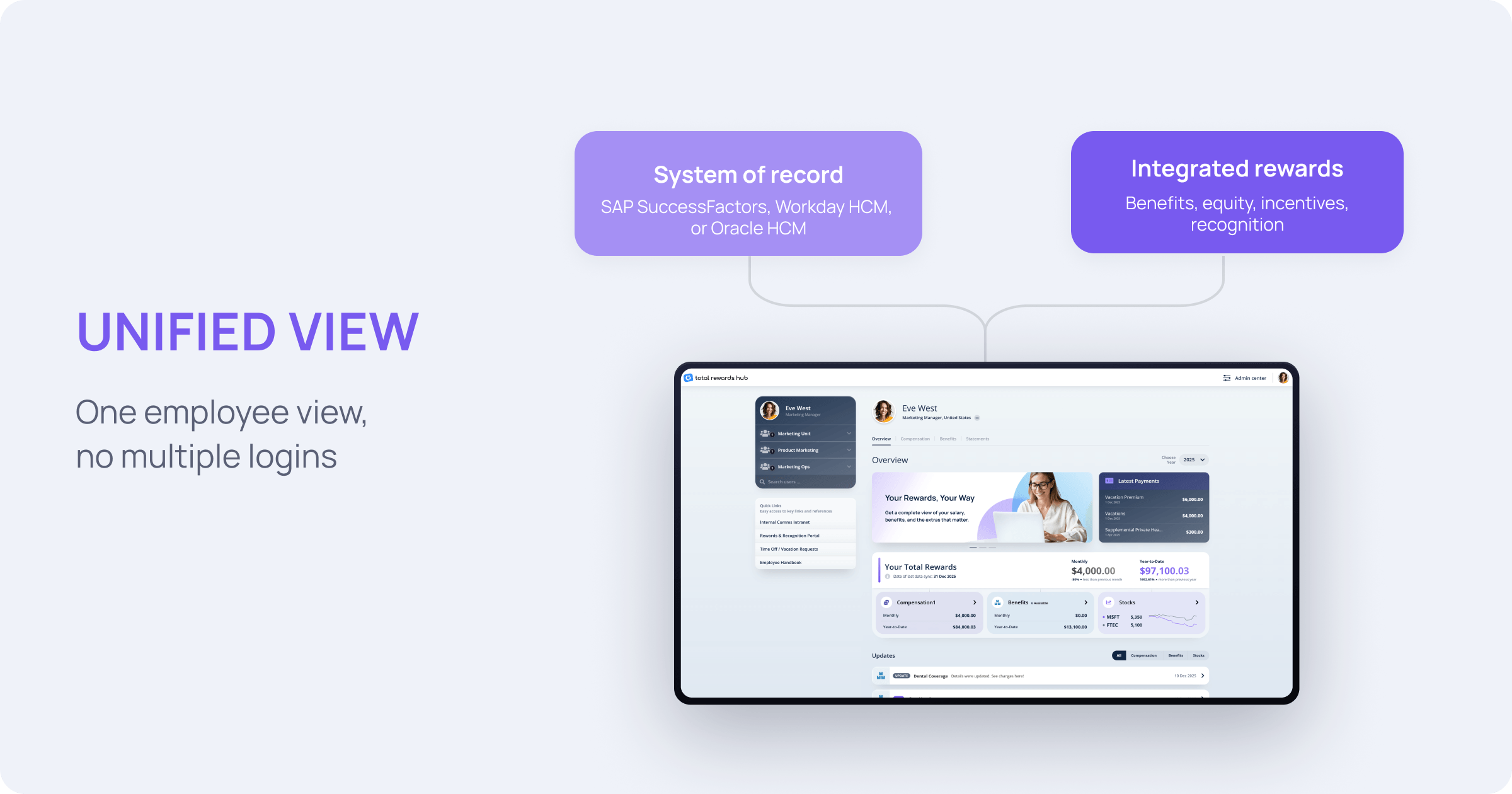
Most enterprises already run an HR portal, annual statements, benefits enrollment tooling, compensation software, recognition systems, and payroll self-service, so another interface simply joins that list. What closes the distance is a visibility layer across those systems. Our total rewards solution, Total Rewards Hub, works this way. It integrates with SAP SuccessFactors, Workday, or Oracle Cloud HCM as the system of record for employment and pay. Everything else, benefits, equity, incentives, recognition, is added alongside it, so the employee sees one view instead of six logins and a PDF. That is the part an HCM alone was never going to cover.
Evaluation criteria for a total rewards visibility model
You probably have parts of this already. The real question is whether what you have covers all four levels, for every employee group, with numbers people can trust. That is a higher bar than producing a statement on schedule.
- Information available on demand, updated as source data changes.
- One view spanning compensation, benefits, incentives, and recognition.
- Communication triggered by employee events rather than by a date.
- Reach across the whole workforce, including employees without corporate email or regular desktop access.
- Role-based access and permissions.
- Country and employee-group configuration, with local currency and language support.
- A clear view of where each number comes from and when it was last updated.
- Analytics on what employees open and use, plus a feedback channel inside the experience.
The lower half of that list is where single-purpose tools tend to stop. A point solution can produce a clean interface for one reward component, but global consistency, governed permissions, and numbers people can trace are what make it work across every population you employ.
[cta]
What changes once visibility becomes a system
Here's what improves once total rewards move from a once-a-year document to a continuously updated system:
A defensible case for reward spend. Utilization and engagement data turn "we think this program matters" into evidence you can bring to budget conversations, making it easier to justify what you're already spending and prioritize what to expand.
Lower administrative effort. Self-service absorbs the repetitive questions that currently land on your team and cuts the manual work of building and distributing statements every cycle.
More awareness, stronger utilization. Timely, event-based communication puts benefits and programs in front of employees exactly when they're relevant.
Real appreciation for what's already being offered. When rewards are visible, relevant, and easy to use, employees can truly register the value behind them.
Stronger position in retention conversations. Employees comparing offers can weigh their full package instead of just the parts they happen to remember, keeping valuable rewards part of the decision instead of invisible at the exact moment they matter.
The business case for total rewards visibility
The reward leader who described the statement process was describing something real. It exists, it goes out, it covers what it covers. It was built to summarize a period, and full responsibility for employee understanding arrived long after the design was set.
The reason to close that distance is financial. Enterprises commit enormous budgets to compensation, benefits, equity, pensions, and recognition, and that investment only returns what employees can perceive of it. A benefit nobody knows they have earns nothing. An equity grant nobody can value competes badly against an external offer that arrives as a single clear number. Every reward an employee cannot see or interpret is spend working at a fraction of what it cost.
Visibility is how that investment becomes legible. Employees see what they receive and why it matters. Managers hold pay conversations with context instead of guesswork. Compensation and benefits teams stop rebuilding the same explanations every cycle. And the organization gains a consistent, defensible account of how it rewards people, which is what turns pay communication from an annual exposure into a durable source of trust.
None of this requires rebuilding your reward programs. They already exist, and the budget behind them is already committed. What is left is making them visible, and that is a solvable problem. The data is there, the systems are already running, and pulling them into one clear view is well within reach for a team that decides it matters.
[cta-2]


Explore related articles

Ready to unify your people programs?
Stop running recognition, rewards, communications, and development in silos. See how Semos Cloud brings it all together in one AI-powered platform, built for enterprise, certified for compliance, and proven at scale.