Insights for modern HR leaders

At SAP Connect 2026, Deloitte and Semos Cloud showed how Deloitte replaced a homegrown nomination tool and a separate gift card vendor with one Recognition Hub for 200,000 professionals in the US and India. Powered by Semos Cloud, the Recognition Hub brings recognition into one place, with award data governed in SAP Business Data Cloud alongside SuccessFactors and S/4HANA.
Four months after go-live, adoption has set a new record every month. Each award is now a structured data record that captures the behaviors and values Deloitte wants to encourage.
.png)
How Deloitte and Semos Cloud scaled recognition to 200,000 professionals, with the data on SAP BDC
Deloitte worked with Semos Cloud to replace two disconnected systems with one Recognition Hub for 200,000 professionals, with the recognition data governed in SAP Business Data Cloud. The SAP Connect 2026 session recap: what they required, what they learned, and where the data goes next.
- Manager enablement needs to carry through into everyday decisions and conversations.
- Recognizing a problem is only the beginning; managers also need practical guidance on how to respond.
- The value of manager-focused AI should be measured through its contribution to engagement, retention, and better people management.
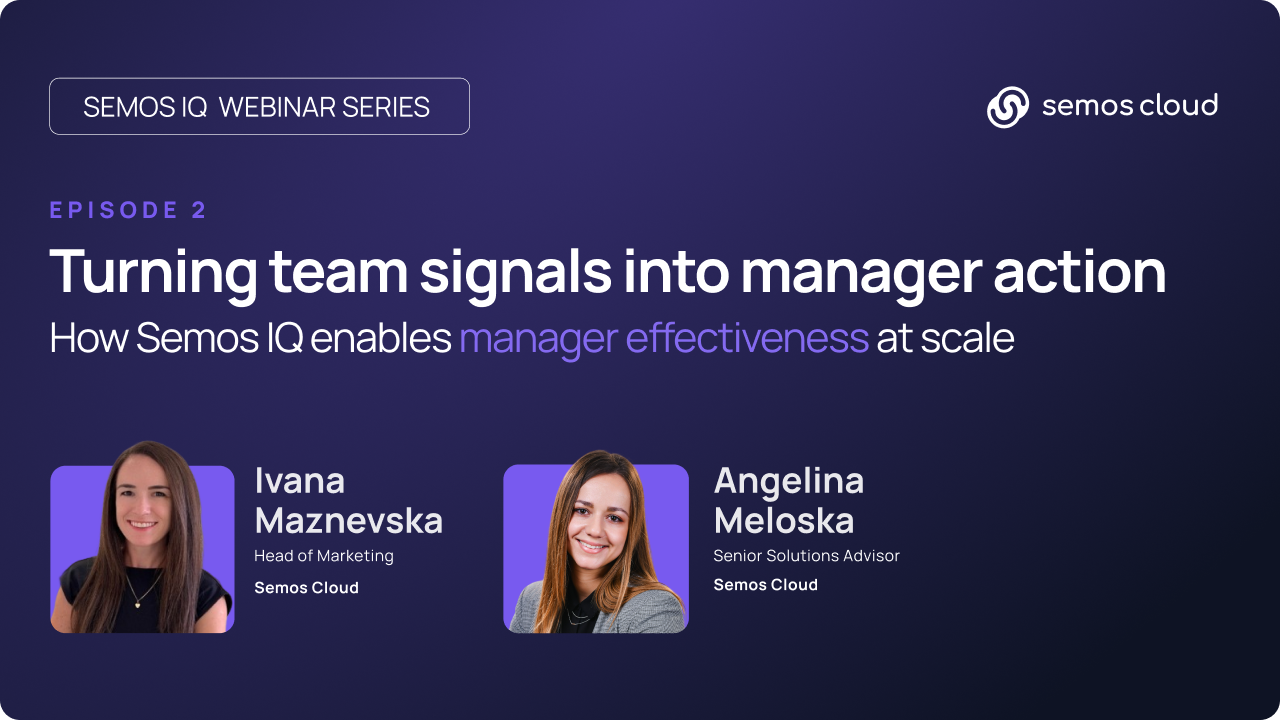
Turning team signals into manager action
Explore how Semos IQ connects people signals to practical manager support, helping HR work toward stronger engagement, retention, and manager effectiveness.
- Europe adopts employee recognition when it feels relevant and appropriate, not just exciting.
- Build GDPR, works council requirements, and award tax rules into the employee recognition program from the start.
- Use two different behavioral models on one employee recognition program instead of treating Europe as one market.
- Report by cultural cluster, with unique sender rate as a key measure.
- Use European hubs to connect employee recognition across countries and regions.
Employee recognition in Europe: built on legitimacy, not enthusiasm
Explore employee recognition in Europe: how GDPR, works councils, and cultural differences shape adoption, with guidance for global HR leaders.
Building a successful global recognition program means looking at the full picture: recognition volume, who is participating, the balance between manager and peer recognition, access for frontline employees, and how recognition behaviors vary across cultures and markets. Keeping these factors in mind helps HR build a program that can scale while still fitting the needs of different employee groups and local contexts.
Employee recognition in the Americas: volume vs. participation
Explore employee recognition in the Americas through award volume and sender participation, with guidance on interpreting program data.
We've partnered with Dubai-based culture and change communications specialist Yulia Kurdina to bring a dedicated employee communications layer to HR technology deployments across the Middle East and North Africa.
There is a moment that every HR leader who has run a platform rollout will recognize. The system is live. Integration is clean. The launch email went out. And three months later, usage has settled somewhere well below what anyone projected.
The technology worked. Something else did not.
This is the problem we are addressing with our new partnership. Semos Cloud has partnered with Yulia Kurdina, co-founder of Culture Co and a Dubai-based culture and change communications specialist, to bring a dedicated employee communications layer to HR technology deployments across the MENA region.
The adoption problem in HR technology, and our new partnership with Yulia Kurdina
Platforms go live and usage stalls. Why HR technology adoption is a communications problem, and our new partnership with specialist Yulia Kurdina.
People programs rarely fail loudly. Messages get sent but never received. Survey data exists but sits in tools that do not talk to each other. Scores look stable right up until someone resigns. Episode 1 of the Semos IQ Series named the three gaps that produce that pattern, then worked through a live scenario inside Semos IQ: a survey built, another survey's results read, the diagnosis underneath them, and finally the specific employees and managers who could act on it. Four agents, one conversation, every decision made by a person.
Are your HR programs improving employee experience?
Communications are going out, surveys are running, recognition is active, and engagement still drops. Episode 1 of the Semos IQ Series names the three gaps hiding underneath all that activity, and shows what closes them.
- Semos Cloud was named a Major Contender in the Everest Group R&R Solutions PEAK Matrix® Assessment 2026 – a major validation for our growth and vision
- HR programs mature along a five-stage curve: from fragmented core operations to autonomous, agent-driven action inside boundaries HR itself defines.
- Most organizations, and most vendors, sit in stages one and two. The real differentiator is turning a connected employee experience into workforce intelligence, then into AI-powered action.
- Stage five, Autonomous HR, is unsolved industry-wide. It requires trustworthy workforce intelligence and human-defined boundaries before any agent should act on its own.
.avif)
Semos Cloud named a Major Contender in the Everest Group 2026 R&R Solutions PEAK Matrix® Assessment
Semos Cloud was named a Major Contender in the Everest Group 2026 Rewards and Recognition (R&R) Solutions PEAK Matrix® Assessment. Explore the five-stage maturity journey from recognition to people and culture intelligence.
- A total rewards statement and total rewards visibility aren't the same thing, even though most organizations treat them as interchangeable.

Total rewards statements vs. visibility: what's the real difference?
Having a total rewards statement isn't the same as giving employees visibility. Here's the gap most HR teams don't realize they have, and what closes it.
- The EU Pay Transparency Directive transposition deadline was June 7, 2026. As of mid-June, only four member states (Italy, Slovakia, Lithuania, Malta) have full implementing law in force. Most major economies are behind.
- 17 U.S. states plus Washington, D.C. now have active pay transparency laws, layering an additional compliance map for multinational employers.
- Pay transparency is the visible question. Four operational layers sit underneath it: job architecture, data consolidation, governance and communication, and manager capability. They have to land together.
- 37% of organizations name manager inability to explain pay as their single biggest transparency hurdle.
- The four layers stop being four projects when they live inside one platform purpose-built for the work. Total Rewards Hub, built on SAP BAIP, is the Semos Cloud platform for that.

The four layers of pay transparency readiness: A recap from HR Connect Paris 2026
Around 450 HR leaders met at HR Connect Paris on June 16, 2026. Here is our recap on where pay transparency readiness stands across European enterprises, the four layers underneath, and what Total Rewards leaders should do next.
Employee Appreciation Day lands differently depending on where your workforce is. In the Middle East, celebrating people well is not just a feel-good initiative. It is one of the more complex operational and cultural challenges an HR team can take on.
The region’s workforce is characterized by extraordinary diversity: dozens of nationalities working side by side, multiple languages spoken within a single building, frontline employees who may never open a laptop, and cultural expectations around leadership visibility and public recognition that differ meaningfully from Western norms.
At the same time, the talent market is competitive, employee mobility is high, and the expectation that employers will invest in the whole person, not just the role, is rising.
Recognition carries particular weight in this context because compensation budgets have limits. When salary adjustments are constrained by headcount growth, market conditions, or annual cycle timing, structured appreciation becomes one of the most reliable levers HR leaders have to sustain morale and keep people engaged. Organizations that understand this treat recognition not as a reward on top of compensation, but as a sustained investment in the employee relationship that operates independently of it.
This guide draws on the experience of enterprise organizations across the region, from integrated retail and lifestyle businesses to advanced technology groups and diversified industrial organizations, to explore five dimensions of employee appreciation that HR leaders need to get right.
These are practical design decisions with real consequences for whether your recognition program lands or goes unnoticed.

What meaningful employee appreciation looks like in the Middle East
A practical guide for HR, Total Rewards, and People and Culture leaders on building recognition programs that work across the Middle East's diverse, multilingual, and largely deskless workforce. Five dimensions that determine whether your program lands or goes unnoticed.